All
/
WINE
Wine aerator vs decanter: what's actually the difference?
21.09.24
•0 min read
21.09.24
•0 min read
Someone's 20 minutes away, there's a bottle open on the side, and you're holding a small silver contraption you bought in a moment of enthusiasm, wondering if it actually does anything.
This is when the wine aerator vs decanter question gets asked: “Should I use one, and if so, which one?” Most people just guess.
A wine aerator treats one glass in seconds, pulling air into the wine as it pours. A decanter treats the whole bottle over hours. Both increase the wine's contact with oxygen. Neither turns a wine into something it wasn't born to be.
Here's what each one does, what's happening in the glass while it does it, which bottles want which, the one job neither of them was built for… and the option that actually does both and skips the choice entirely.
A stand-alone wine aerator is a small thing you pour through: some are a wine aerator pourer that sits right in the neck of the bottle, some you hold above the glass as you pour, some are electric and do the work for you, and some have an aerating pour built into the design itself. In the latter, the wine picks up air on the way in rather than needing a separate device at the glass. It's the more elegant version of the same idea: one pour, one motion.
What they all share is a narrow channel. Wine moving fast through a tight space drags air in behind it (called the "venturi” effect), and the wine lands in your glass already mixed with oxygen. Instant. One glass at a time.

Older wines throw a deposit. Colour pigments and tannins bind together over years and drop out of solution, and in whites and rosés you'll sometimes find tartrate crystals too, which are entirely harmless. None of it will hurt you. But all of it is gritty, bitter, and unwelcome in a glass.
Pouring a bottle slowly into a decanter, against a light, lets you stop the moment the sediment reaches the neck.
This is the decanter's original job, and it's one a wine aerator can't do on its own.
The second job of some decanters is the one everyone already knows. A wide-bottomed decanter spreads the whole bottle across more surface area so more of it touches air, and it happens gradually enough that you can taste your way through it.
The third job is that it looks rather better on a table than a bottle does. That's already a real reason to own one. It’s a large part of why we spent so long getting the shape of the ETO decanter right, not just the science inside it.
Mature reds, above all Bordeaux, Barolo, and anything with 10 or more years on it from a good cellar (or a lucky corner-shop find). Unfiltered and low-intervention wines, which are made to keep their solids. And vintage port, which throws more sediment than almost anything else, and is the reason port decanters exist as their own category.
This is what makes the decanting vs aerating question rather more interesting than a quick search would suggest.
Start with reduction, because it's the most useful. Some wines arrive smelling of struck match, rubber, or drains, caused by volatile sulphur compounds known left over from fermentation. Air fixes this. Aerating a wine containing these mercaptans oxidises them into disulphides, which is the chemistry behind a wine that smells shut down on opening and clean 15 minutes later.
There's something borderline magic about that: the same wine, 10 minutes apart, smelling like two different bottles.
Tannin softening is the other half of the story. Short-term decanting softens wine by allowing alcohol and reductive aromas to evaporate, unmasking fruit compounds and creating the sensory illusion of smoother tannins. This process results from aeration rather than a physical change in the wine's phenolic structure. That physical change only unfolds over months in a barrel, not the 20 minutes before your guests arrive.
Then there's dissolved carbon dioxide, which many young wines carry over from fermentation. It reads as a faint prickle on the tongue, and blows off within minutes of hitting air. Nothing to do with tannin. Everything to do with why a young white tastes rounder by the second glass.
It really comes down to time and fragility. Here's how to read your bottle.
Yes, and it's worth knowing what that tastes like: the fruit goes flat, the aromatics thin out, and the wine reads as tired rather than open. That progression of oxidation can be described as a dulling of the aroma first, then cardboard, straw and hay, then sherry-like and madeirised characters as it goes further.
It happens far faster with a wine aerator than a decanter, for the obvious reason that a decant is gradual and you can taste your way through it. So taste the wine the moment you open it, taste it again 20 minutes later, and let the direction of travel tell you what it wants next.
Both of these devices do real work on the glass in front of you. Neither has much to say about the two-thirds of the bottle you're not drinking tonight. And that's where the real waste happens: by some estimates, tens of millions of litres of wine get poured down British drains every year, most of it from bottles opened with the best intentions and forgotten by Wednesday.
A wine aerator's job ends the moment the glass is full. A decanter's job, brilliant as it is for that first hour, doesn't really end at all, it just keeps going: widest possible surface area, maximum air sitting above the wine, still working away long after everyone's gone to bed.
The exact openness that helped at 8pm is working against the bottle by 10pm.

This is the gap ETO was built to close, not by picking a side but by doing both jobs in a measured way. It's a moderate aeration, not a maximal one. A powerfully reduced young Barolo or a tannic Northern Rhône Syrah that wants a real jolt of air will still do better with a wide-bottomed decanter or a dedicated aerator built for speed. What ETO gives up in that top-end intensity, it makes up for by doing a good job of it every time, for every wine, without needing a second tool on the side.
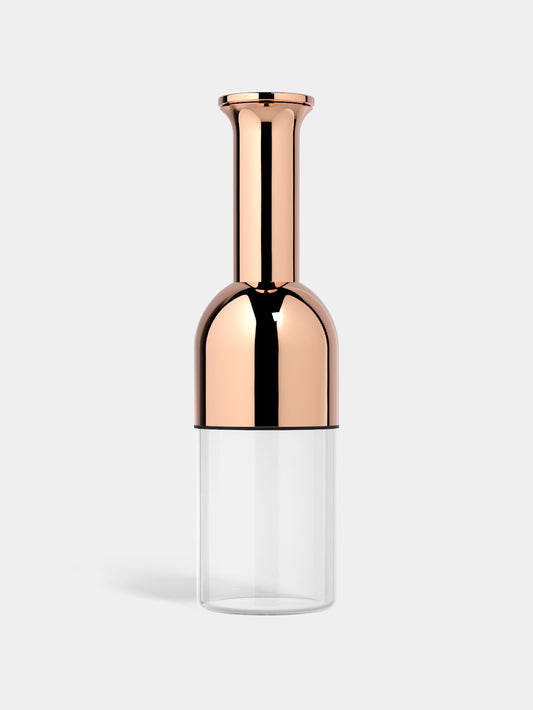
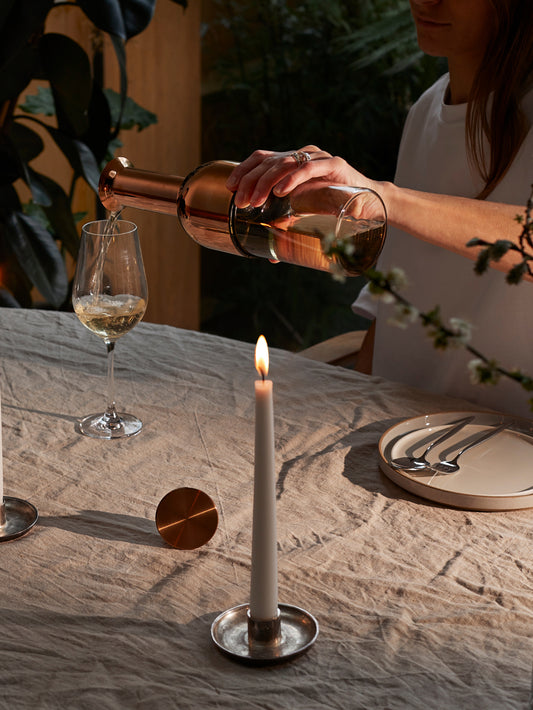
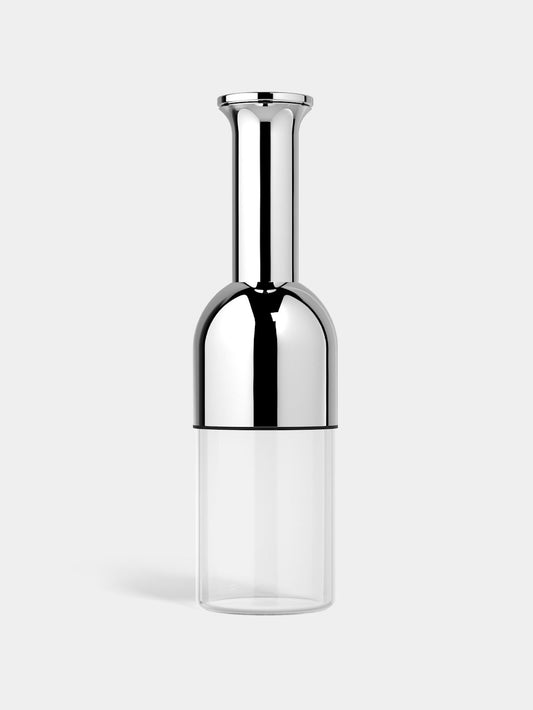
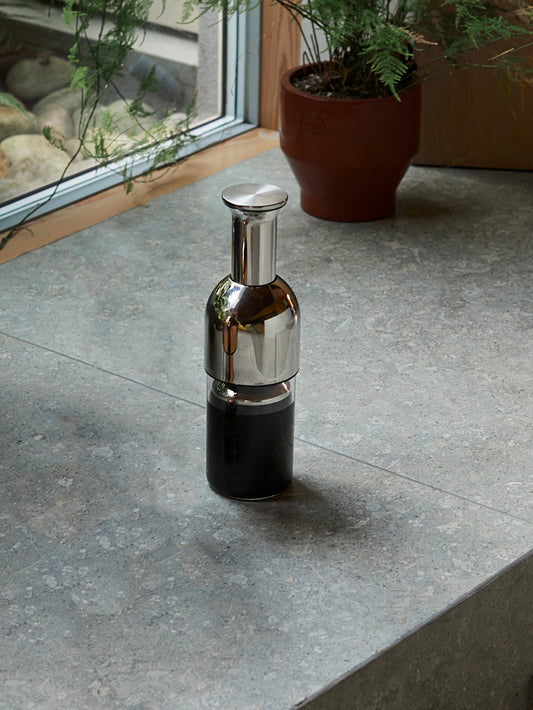
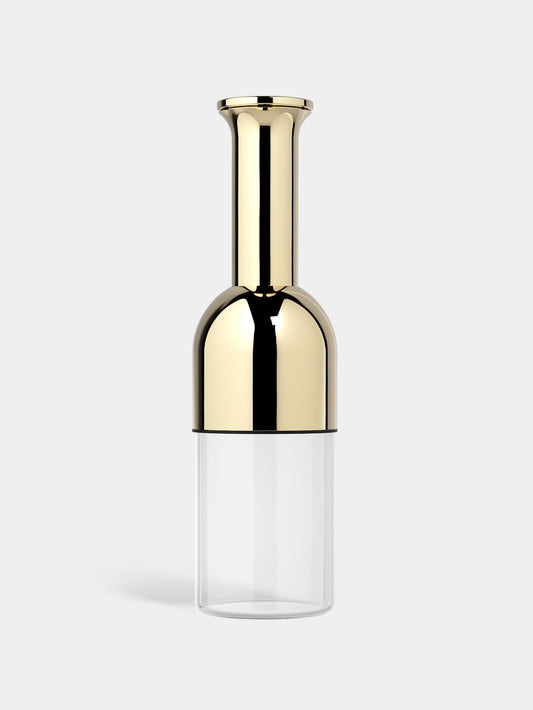
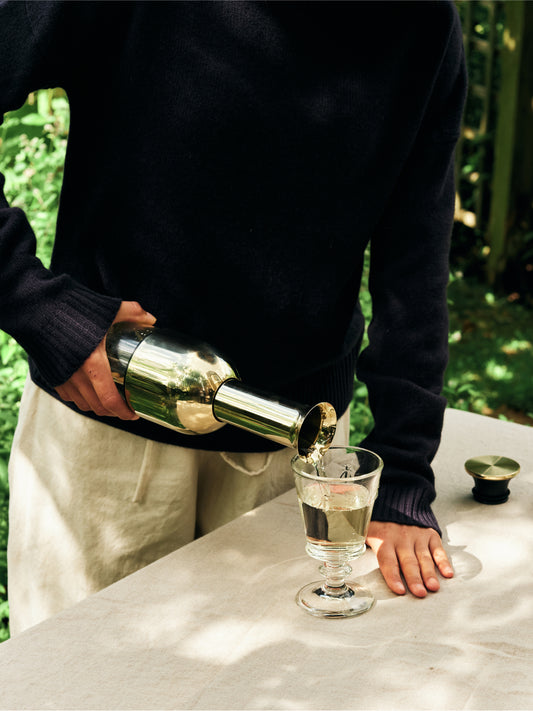
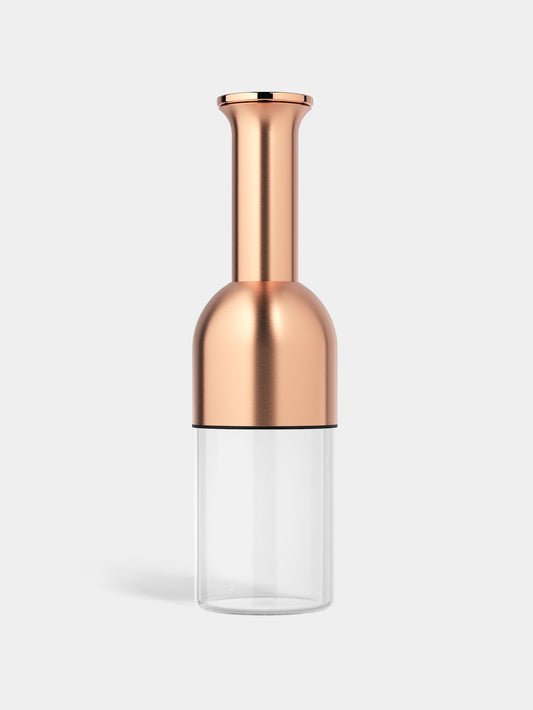
Pour your bottle in exactly as you would with any decanter, and the long funnel does an aerator's work on the way down, gently oxygenating the wine as it goes while the sharp pouring lip keeps things clean and any sediment stays behind. Then replace the closure, push the neck down, and the seal locks itself the moment it meets the surface of the wine. No pumps, no gas, no refills. What's left is protected from all three of wine's greatest enemies, oxygen, light and heat, for up to two weeks (14 days). The last glass tastes as good as the first. Sometimes even better.
We'd rather show you the evidence than simply assert it. We spent 12 months in laboratory testing at Bangor University, measured against other preservation systems, and separately went through blind tastings with Master of Wine Richard Hemming, who found no perceptible difference between a freshly opened bottle and an ETO-stored sample on the seventh day.
Not as two separate devices, no. A decanter already givesyou the capability to aerate, since a slow pour does the same job as a quickone, just with more control. The case for keeping a standalone aeratoralongside it is narrow: an instant glass on a weeknight versus a slow decant ona Sunday. Simplest of all is a decanter that already does the aerating pour onthe way in, so there's nothing extra to own or find room for.
It depends what you drink, though you don't really have tochoose. Young, tannic reds want that instant lift of air, while everydaybottles, whites, and older wines are often happiest with a slower, gentlerpour. A decanter with an aerating pour built in gives you both from the samebottle, so you can match the pour to the wine without owning two separatetools.
You can, by pouring through the aerator into the decanter, or you can skip the two-step: ETO's long funnel aerates the wine as it decants, so anything from a delicate white to a tight young red gets the right amount of air from a single, elegant pour.
You can, and sometimes you should. Full-bodied whites gain from air, and so does any white showing a struck-match note when you open it. The rule against decanting whites is more of a traditional convention, and shouldn’t be the definite call. Orange wines, with their tannic structure, often reward it too.